Stay on Offense Climb Mountains

Attacking Adversity

  • Keep Moving Forward
  • Go Hiking
  • Ideas to Stay on Offense
  • Bookish Weapons
  • About Bill Montgomery
    • Log In
    • Membership Account
    • 1-Time Donation
    • Contact Coach Bill
      • Thank You & FAQ
  • Facebook

Bookish Weapon Number Forty-Two

July 3, 2020 by Bill Montgomery Leave a Comment

“Falling Upward,” by Richard Rohr is about, as the subtitle says, “A Spirituality for the Two Halves of Life.” It is a thoughtful book by a well known Franciscan priest.

It is a good book for people who are in the second half of life and are wealthy enough to be able to partake in all that the second half offers. In fact, it is also an interesting book for those that are just old, but are still living in the first half.

First Half

Rohr points out that we are a “first-half-of-life culture,” largely concerned about surviving successfully. I would add, or just surviving. He says, “We all try to do what seems like the task that life first hands us: establishing an identity, a home, relationships, friends, community, security, and building a proper platform for our only life.” Yet, many, will not accomplish the first half of life in their entire lifetimes, clinging tenaciously to basic survival.

“You need a very strong container to hold the contents and contradictions that arrive later in life.” If you don’t have that strong container it’s tough. He says, “In fact, far too many (especially women and disadvantaged people) have lived very warped and defeated lives because they tried to give up a self that was not there yet.”

Tragedy

“The Tragic Sense of Life,” is the title of one of the chapters in this book. I thought it made a lot of sense. He says that the Greek word for tragedy means “goat story.” I thought that was funny because I have been referred to as a “Billy goat,” due to my hiking. The idea however is that we can grow from tragedy. Rohr says, “It all depends on whether we are willing to see down as up; or as Jung put it, that “where you stumble and fall, there you find pure gold.” “Lady Julian put it even more poetically: “First there is the fall, and then we recover from the fall. Both are the mercy of God.”

He says, “I am personally convinced that Jesus’ ability to find a higher order inside constant disorder is the very heart of his message – and why true Gospel, as rare as it might be, still heals and renews all that it touches.” That is a profound statement and it certainly rings true. Order and chaos are a part of life, in constant ebb and flow.

Second Half

“In the second half of life, we do not have strong and final opinions about everything, every event, or most people, as much as we allow things and people to delight us, sadden us and truly influence us.” What a great way to live! The older I get the less I think I know for sure about anything yet I have met many older men who have set their opinions in stone. Rohr says, “It always deeply saddens me when old folks are still full of themselves and their absolute opinions about everything.”

People who do the second half of life well have combined their occupation and their life so that their “delivery system” is one. He says, “Your concern is not so much to have what you love anymore but to love what you have – right now. This is a monumental change from the first half of life, so much so that it is almost the litmus test of whether you are in the second half of life at all.”

This book continues with a look at the shadow self. Shadow work is a topic in many books these days, but I think this one offers unique insight. So buy the book! You will be glad you did. After all, it is another bookish weapon.

Filed Under: Bookish Weapons, Ideas to Stay on Offense Tagged With: adversity, aging, Bookish Weapons, emotions, meaning, self-help, struggle, success

Bookish Weapon Number Forty-Two

June 13, 2020 by Bill Montgomery Leave a Comment

Jim Kwik is a well-known speaker and author who hangs out with the likes of Tony Robbins and other life coaches. His latest book, “Limitless,” is another great contribution to the self-help genre. It is almost three-hundred pages long.

Even though this is a great contribution, I expected more. Maybe it is because I have taken other speed reading and memory improvement courses so I was looking for something I did not already know. The older I get the more I run into this.

Motivation

One of the additions Kwik made to this book is contained in the title. The idea that we can become limitless like the popular movie with Bradley Cooper from 2011. Who’d doesn’t want to be limitless? I like what he says at the beginning of the book, “If an egg is broken by an outside force, life ends. If broken by an inside force life begins. Great things always begin from the inside.”

Later in his chapter on motivation, Kwik breaks down the “Why” into three areas, Mindset, Motivation, and Methods. The chapter is called Limitless Motivation. He discusses the importance of purpose, but first gives us a formula: Motivation = Purpose x Energy x S (to the 3rd – cubed). The S-cubed stands for small simple steps.” Good formula.

I like his discussion about goals and how he adds HEART goals to SMART goals. “Heart” stands for H- healthy, E – enduring, A- Alluring, R – Relevant, and T-Truth.

He doesn’t leave out discussing belief systems either. Anyone that Tony Robbin’s influences are going to discuss limiting beliefs and how to overcome them.

He also brings up “Primary Questions,” which are a trademark of Tony Robbins, but Jim Kwik calls them ”Dominant Questions.” A primary question or “dominant” question is the question we ask ourselves over and over across contexts. For example, “How can I survive,?” could be a Primary Question. Then you take yourself through the process of finding a better Primary Question.

Reading Fast

Kwik has a lot to say about how to read faster. It is one of his staples. So here is a recommendation: Use your finger to scan the lines. That by itself will increase your reading speed. It makes me nervous and I read to relax so it doesn’t work for me although it does work.

Another tip is how to reduce subvocalization by counting while you are reading.

He quotes Mark Twain at the beginning of this chapter and I love this quote: “The man who does not read good books has no advantage over the man who can’t read them.”

Remembering

You remember better if you test yourself on the material by asking questions to force you to recall and related study. Spaced review increases learning. Reviewing is key. If you do not review material you will eventually forget it.

Of course, Kwik and other memory experts all use the Memory Castle approach to memorizing phone numbers or names or lists of any kind. It was initially discovered in Roman times. You have many “castles” in your life. They are “locations” where you have spent time. Your living room, bedroom, the grocery store you frequent. You begin in one corner of a room and pick out objects in the “castle” or room like a bookcase, advancing in one direction around the room. Then you use your imagination to tie something you want to remember to that location. Simple! Not necessarily easy. You need to develop your imagination. Kwik discusses this in detail.

There is so much more in this book so please get it and read it! It is a great bookish weapon.

Filed Under: Bookish Weapons, Ideas to Stay on Offense Tagged With: Bookish Weapons, focus, memory, reading, self-help, success

Bookish Weapon Number Forty-One

May 16, 2020 by Bill Montgomery Leave a Comment

“The Pleasure Prescription,” by Paul Pearsall, Ph.D. was written in 1996. It is still timely and I think a classic self-help book. So here we go.

Aloha vs Haole. Aloha besides meaning “Hi,” is the word for our seventh sense, the instinctive drive to do what is pleasurable and healthful. Haole means “without health.” The author says his book is about “rediscovering your sense of aloha.”

What I Liked and Didn’t Like

Pearsall says you can get enough exercise just by walking a few times a week. I disagree with this, but won’t belabor it. There are a lot of things in the book the make sense.

I liked this. “If you want to bring pleasure into your life, be a person who brings great pleasure into life – and into someone else’s life.” I agree! If you think you are adding to someone’s day even if it is just to make it a tiny bit more enjoyable then it will make your day too.

Relationships

One of the most impactful observations Pearsall makes is about relationships is drawn from the Polynesian culture. He quotes a Polynesian kahuna, “All bonds are forever. Divorce never annuls a relationship, and if you want to find joy, stay closely related to others and the world. The brain may think it has voided a commitment, but the heart does not think that way. Like a loving child, once it has loved, the heart loves forever, no matter what. You can never truly separate, even if you live a world away. It is a law of physics and a law of Polynesia. Once things join, they are transformed by their joining and are One forever.” That has stuck in my mind over the years and I think it is what really sets his book apart from the rest.

If you take the above statement to heart you will approach relationships with a far more serious and thoughtful mind. How many people are you One with that you thought were just a pause that refreshes? Think about that.

Urgency

Now here is something to consider. In the world of time management, they tell you to separate what is urgent from what is important and to know the difference. Pearsall discusses urgency in a different light. He calls it the “Urgency Response.” Some people are always under its spell. If you were raised in a violent home then you are constantly “ready.”

Pearsall says, “The urgency response is not just a psychological state, but also a physiological one. A state of prolonged urgency gradually kills us and threatens those around us by weakening our immune system, stressing our heart, and prematurely aging all of our bodies ’ systems.” Then he quotes Albert Camus who says, “If there is a sin against life, it consists perhaps not so much in despairing of life as in hoping for another life and in eluding the implacable grandeur of this life.”

Balance is the key says, Pearsall. “Healthy balance and oscillation is the key to the pleasure prescription. Just as too much happiness too often and too long can cross over to psychotic delusion, chronic unhappiness and internal stress from perceived helplessness and lack of joy can cross over to serious clinical depression.” We need to keep the parasympathetic system balanced with the sympathetic. So go get the Nature Beat App and a chest strap so you can check yours every morning.

Pain and Loss

This book is a couple of hundred pages long and I have only taken a few ideas from it so please read it yourself. There is much more to learn between these pages.

However, there is one more quote from the kahuna on pain and suffering that I thought was excellent. “When you are dealing with pain, loss, and suffering, you must remember five things. Be patient, for this too shall pass. Stay connected, for relationships must be strong to make the passing possible. Be pleasant through your pain, for that will bring you the aloha you need to heal and give healing to others. Silence your self-pity and avoid self-blame, for you are only doing what we all must do. Most of all, keep giving your aloha. Don’t use your suffering, share it by opening up to others, teaching them what you are learning from your pain, and holding and comforting them to let them know that they too will be safe when it comes to their turn.”

Filed Under: Bookish Weapons, Ideas to Stay on Offense Tagged With: adversity, Bookish Weapons, emotions, Health, pain, self-help, struggle, success

Bookish Weapon Number Forty

April 25, 2020 by Bill Montgomery Leave a Comment

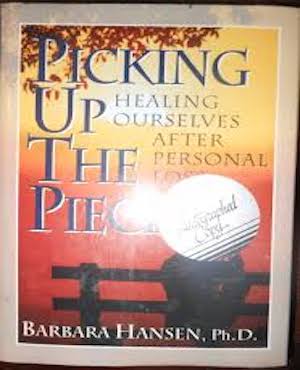
Today we are going to revisit the author Barbara Hansen by looking at another one of her other books, “Picking Up The Pieces.” We looked at “The Strength Within,” in another Bookish Weapon post.

In this book, Barbara explains what happened to her when she was nineteen years old and how that changed her life. Then she discusses the things that allowed her to thrive in the future. She says her realizations can be life-changing for us. Here are a few.

Time Doesn’t Heal Us: We Heal Ourselves

We choose how we respond to loss. She says, “I am convinced that we’re destroyed not so much by forces outside ourselves as by forces within.” We choose how we respond to loss.

She dislikes the phrase “Time Heals” and says it implies “that id we just keep breathing long enough our sorrow and grief will vanish. Nonsense. I’ve watched too many people walk through loss to accept the idea that “time heals.” The more accurate statement is “time numbs.”

Develop Internal Resources

Barbara discusses five internal resources that we can develop. These are so helpful.

Believe in your own uniqueness – “…affirm that life indeed has a pattern and determine how we fit into that mosaic.
Discover Success is Intangible – “…It is what we are and not what we have that makes us successful.”
Listen With Love – Focus on others and listen to there problems
Live Life In Small Slices – Live in the moment and not for the moment diminishes our pain.
Invest In Solitude – Get acquainted with your internal self and discover new strengths.

Exploring Some of These Five

She has a personal theology where she believes God is Love and she is a channel of that Love. This gives her meaning. And she says no matter your religious beliefs: “each of us is a tiny piece of the mosaic of life. Before we can successfully walk through a loss, we need to affirm that life does indeed have a pattern and determine how we fit into the total picture.”

She goes on to say that she believes she is a valuable piece in life’s pattern. A loss does not erase a person’s uniqueness. “Believing in your own uniqueness gives you the strength to pick up the pieces.”

She measures her success by asking herself the following questions:

Am I a loving, kind, caring individual?
Am I filled with inner peace, serenity, and stability?
Am I positive, joyful and content?
Do I like the person I am becoming?
Do I welcome each day?
Do I laugh easily?
Do I enjoy my friends and family?
Do I have a good relationship with God?
Do I have something to hope for, a goal I’m working toward?
Do I have someone to love?

These are fantastic questions to ask yourself even if the answers might make you very uncomfortable.

This book is out of print, but there are used copies available from time to time. If you can find it get it. There is so much more in the book.

Filed Under: Bookish Weapons, Ideas to Stay on Offense Tagged With: adversity, Bookish Weapons, emotions, exercise, hiking, self-help, struggle, success

Bookish Weapon Number Thirty-Nine

April 18, 2020 by Bill Montgomery Leave a Comment

Brendon Burchard is a motivational speaker and ever-present online video encourager. He has written several books and one he wrote in 2012 had an impression on me. It is called, “The Charge.”

As with all of his books Brendon is passionate. I underlined the following right at the beginning of the book:

“The Charged Life, the truly lived life, is not routine existence in some quaint, picturesque village of safety and certainty. No, the life with living is out therein the wooded wilds of the unknown, on the craggy battlefields that test our wits and wills in the daily fights with our own demons.”

All The Lives

The author discusses other kinds of lives that may not be so “charged” such as the “caged life,” and the “comfortable life.”

The caged life is when you live in the past or in the expectations of others. You think you are stuck and can’t make the changes you need to make and have to be a certain way. You are asking “will I survive.” Brendon says unless life flips you upside down it is very hard to get out of this, but it can be done.

The comfortable life is “an everything is ok” kind of life. A ho-hum existence. It isn’t like a cage but more like a rut he says.

The Charged Life “calls to us after we have done what we were supposed to do, become who we thought we were supposed to be, lived as we thought we were supposed to live.”

The Motivation

Most motivational speakers use information from other motivational speakers. Tony Robbins borrows from Jim Rohn and others. Burchard borrows from Tony Robbins when he discusses human drives. He talks about how you control the meaning of everything or as Tony said it, “Nothing has any meaning except the meaning we give it.”

Burchard goes on to advise you to not spend your time on time wasters. In 2020 that would be on your phone. He mentioned TV and surfing the net. And then he says “For every bit of data that comes into your life, your brain attaches meaning and emotion to it.”

Competence

Burchard discusses the ten human drives. One of them is competence. It is important. When we are doing well and conquering our world we reinforce the feeling of competence. He calls this the “competence-confidence loop.” Then he says, “…the second our internal competence scale tips from self-assured to self-doubting is the moment we begin feeling defeat. We start questioning our ability, intelligence, strengths – or entire future.”

He says that if we can understand our world, perform in it and master it then we have competence. If not we don’t feel competent. If we know we can “figure it out” we are good. He says, “Personal agency is a term psychologists use to describe how confident you feel in your ability to control your actions and shape the outcomes in your life.” This is important.

There is so much more in this book but I thought the above was the best.

Filed Under: Bookish Weapons, Ideas to Stay on Offense Tagged With: adversity, Bookish Weapons, self-help, struggle, success

Bookish Weapon Number Thirty-Eight

April 11, 2020 by Bill Montgomery Leave a Comment

John Mark Comer’s book, “The Ruthless Elimination of Hurry,” is a tough one for me. On the book cover the word “Hurry” is crossed out. Gone. This kind of goes against my philosophy. I am always saying, go fast up that mountain.

Actually I am always rushing through things to the point where they are incomplete or shoddy (maybe even this post). I am not sure if I am hurrying toward something or away from something. But never mind that, let’s take a closer look at this book.

Level Seven

In just the first few pages the book taught me something about myself that I didn’t know. I am a “Level Seven.” That must be from these video games that the young whippersnappers play twenty-four hours a day. Ok, I confess, we even had levels back in “Space Invader” days. Anyway, Comer sounds a bit alarmed that he just hit thirty and that meant he was a level three. I am halfway into my seventies so I guess that makes me a level seven and maybe even a seven and a half.

What could be better than being a level seven? The higher the level the more of a master at whatever game you are playing, right? Thanks, Mark!

Hurry Hurry Hurry

Comer or should I respectfully say Pastor Comer, alarmed himself when he realized he was rushing through life. His mentors (maybe level sevens, you think?) told him that he should do everything he could to eliminate hurry in his life. One of the mentors, Dallas Willard, is quoted: “There is nothing else. Hurry is the great enemy of spiritual life in our day. You must ruthlessly eliminate hurry from your life.” Sounds good on the surface.

Being a Pastor he says Jesus was unhurried and therefore if you follow his “Way” you should strive for that as well. Sounds good to me. Even below the surface. Hurry is the great enemy of the spiritual life as Willard says above. Well, can you imagine the current Dali Lama running someplace?

The Evidence

He goes on to make a real case for how unnecessarily hurried our society has become. Smartphones, crammed schedules, rushing here and there.

Comer asks if you think you might suffer from any of a number of things like irritability, hypersensitivity, restlessness, workaholism, emotional numbness, out-of-order-priorities, lack of care for your body, escapist behaviors, slippage of spiritual disciplines, and isolation. Guilty?

The Answer

Comer provides you with a solution to all these problems. They are being silent and solitary once a week. It is called the Sabbath in religious terms. He makes a great case for it if you are Christian and I like to think I am one so of course, I feel guilty for not practicing it. We call that being “convicted.” Simplicity is the second. Have you heard of minimalism? Slowing is the third.

All these practices make sense for everyone, not just Christians. You all know about minimalism so I don’t think I have to belabor that. Sell or give away what you don’t need and don’t buy what you don’t need. Slowing is more interesting.

With “Slowing,” he suggests some practices. They include driving the speed limit, getting into the slow lane, get into the longest checkout line at the grocery store ( I tried, I really tried), get a flip phone or ditch your phone altogether, kill your TV (got that one right), walk slower (NO), and journaling (of course).

I left out a lot, but you get the idea. It may take me a while to implement more of these, but I think it will be worth the effort.

Filed Under: Bookish Weapons, Ideas to Stay on Offense Tagged With: adversity, Bookish Weapons, christian, emotions, hurry, life, meaning, self-help, struggle, success

  • « Previous Page
  • 1
  • …
  • 4
  • 5
  • 6
  • 7
  • 8
  • …
  • 13
  • Next Page »

Live the Life You Deserve

* indicates required

Attacking Adversity

[the_ad id=”192″]

Recent Posts

More Book Summaries

It has been some time since I have done any book reviews here, but that will be changing. Also, hiking season is almost here so more pictures. I will be turning 80 in a few months so it should be … [Read More...]

Go Hiking And Build Your Best Life

Hiking for me is the best part of living the life I want. Being in nature, challenging my body, moving. If you hike you know it can become an important part of your life. At 78 I ask myself, “Will … [Read More...]

Bookish Weapon Number Seventy-Three

Arthur Brooks has written a book that not only includes useful advice but I really like the cover which includes mountains and someone (I imagine it is me) standing on top of one. What better … [Read More...]

Copyright © 2026 · Log in

X
Subject:
Message:
Ajax loader
Share with friends
Share on Twitter Share
Share
Share on Facebook Share
Share
Share on Linkedin Share
Share
Share on Reddit Share
Share
Share on Pinterest Share
Share
Share on Digg Share
Share
Share on Tumblr Share
Share
Share on Whatsapp Share
Share
Share on Weibo Share
Share
Share on Stumbleupon Share
Share
Share on Flipboard Share
Share
Share on Email Share
Share
Share on Print Share
Share