Stay on Offense Climb Mountains

Attacking Adversity

  • Keep Moving Forward
  • Go Hiking
  • Ideas to Stay on Offense
  • Bookish Weapons
  • About Bill Montgomery
    • Log In
    • Membership Account
    • 1-Time Donation
    • Contact Coach Bill
      • Thank You & FAQ
  • Facebook

Bookish Weapon Number Twenty-Eight

January 11, 2020 by Bill Montgomery Leave a Comment

Jen Sincerco doesn’t seem to be shy. Her book’s title speaks to that. “You Are A Badass” carries an extroverted punch. Even the subtitle gets you excited to hear more. Look at this, “How To Stop Doubting Your Greatness And Start Living An Awesome Life.” See, it isn’t how to stop doubting yourself. That would be far too timid and shy.

This is a motivational book with lots of good reminders for all of us. As with most decent books it contains stories. The best one in this book is Jen’s.

Risk

Sincerco says she wanted to make money but also get over her fear and hatred of it. So she attended seminars and then hired a coach by running up credit card debt. Seems familiar to me. At least running up the credit card debt. But that is some serious risk-taking.

What would Sincerco say to that? Well, here is a quote, “If you want to live a life you’ve never lived you have to do things you’ve never done.”

All Of Us

We all have a conscious and subconscious mind. The problem is the subconscious mind has no filter. It takes in whatever you expose it to. Think of your brain as a house with no doors or locks and your subconscious as a room in it. Sincerco doesn’t explain it that way. I do. So, what if people were coming into the room in your house without you being aware of it. Then they start whispering in your ear and you start doing what they tell you to. Spooky.

Ok, back to Jen’s take on all this. She says the following:

“Our subconscious mind contains the blueprint for our life. It’s running the show based on the unfiltered information it gathered when we were kids, otherwise known as our “beliefs.”
We are for the most part completely oblivious to these subconscious beliefs the run our lives.
When our conscious minds finally develop and show up for work, no matter how big and highfalutin they grow up to be, they’re still being controlled by the beliefs we’re carrying around in our subconscious minds.”

Jen says that the first step is to become aware of these beliefs. Then later in the book, she goes deeper.

The Universe

Nobody in today’s secular world wants to use the word, God. In fact, Sincerco refers to the “G” word as if it is a profanity. How sad that is. However, she quickly translates “God” to “Universe” and “Source Energy,” and continues. So if you are a believer just translate it back again.

She says, “we are all connected to this limitless power.” Then she says “the Universe is made of source energy. All energy vibrates at a certain frequency. This means you’re vibrating at a certain frequency, and everything you desire and don’t desire, is also vibrating at a certain frequency. Vibration attracts like vibration.” That’s pretty good! She equates low frequency with negativity so we need to increase our vibration frequency. And then she tells us that, “The Universe will match whatever vibration you put out. You can’t fool the Universe.”

Finally, she says, “In order to truly raise your vibration you’ve got to believe the everything you want is available to you. And the best way to keep this belief strong is to stay connected to Source Energy.”

Self Perception

“It is just as easy to believe we’re awesome as it is to believe we are giant sucking things.” So as Chapter 6 says, “Love the One You Is.” No more self-deprecating humor. “Don’t compare yourself to others…Comparison is the fastest way to take all the fun out of life.”

“You are responsible for what you say and do. You are not responsible for whether people freak out about it.” “What other people think about you has nothing to do with you and everything to do with them.”

Purpose

Here is one I really liked. “When we share what we were brought here to give, we are in alignment with our highest, most powerful selves.” Not sure what you are here to give. Take some action Jen says because action reveals things that thinking doesn’t.

“Tap into what brings you great joy instead of what you think you need to do to survive.” Great advice!

Thoughts and Beliefs

“Your thoughts and beliefs dictate your reality.” I sure wish I could remember that every second of every day. Whatever it is for you. Whatever your beliefs happen to be here is the truth: “AS LONG AS YOU FEED THE BEAST IT SHALL LIVE.” Capitalization is mine. She continues by emphasizing that you have to change the belief before the evidence will appear.

The more I learn about the brain, especially the subconscious, the more I am convinced of the above. Tony Robbins is big on “limiting beliefs.” He teaches you how to change them. The important thing to remember is to continue to change them and continue to condition yourself.

“Lead With Your Crotch”

Ok, Jen gets a little graphic. That is the title of chapter twelve. She is very funny. However, she makes some excellent points in this chapter.

She tells us to “just see what you can get away with.” I like that. It is a good philosophy for everyone but the criminals in society. Here is a good one, “Don’t just hand your life over to your circumstances like a little wuss. You can take your life wherever you want it to go, so go grab it by its nether regions and make doing the things you love a priority.” Can you imagine being married to a woman like this? That would be intimidating!

I loved this book and there is so much more in it. So go buy it now!

Filed Under: Bookish Weapons, Ideas to Stay on Offense Tagged With: adversity, belief, emotions, meaning, purpose, self-help, struggle, success

Bookish Weapon Number Twenty-Seven

January 4, 2020 by Bill Montgomery Leave a Comment

“You Are Awesome,” by Neil Pasricha is an inspiring book and certainly a weapon for you to use as you make your way through this life. This is a fun book with interesting and uplifting stories in it that keep your attention.

End Of The Sentence

What comes at the end of a sentence? A question mark? Maybe, but more often it is a period. Neil suggests that we should all be open to making that period a “…” A what? A dot, dot, dot. This tells the reader there is more to come. You lose a job and it is not just “I lost my job.” It is I lost my job…” There is always more to the story so you need “the quiet courage to change the punctuation.”

He goes on to say that “Everything you do, every path you take, every diagnosis you get, every wall you hit, every setback, every failure, every rejection. All of these experiences are part of the unfinished sentence of your life story.” Isn’t that the best? It is a perfect way to look at everything that happens.

The Illusion

Neil calls it “the end of history illusion.” It is when one thing happens and you decide that is it. Everything is over. My life is over. He puts it so well when he says, “We all think that the way things are now is the way things will always be.” I lost my job and I will never find another. I got a divorce and I will never have another relationship. Well, that is the case with me, but that is another story. Neil says the researchers call this the “end of history illusion.” Then he goes on to say that “everything we go through in life is a step to help us get to a better place.”

Questions

Questions seem to be the answer to a lot of things. Tony Robbins talks about asking higher quality questions and that everyone has a “Primary Question” they ask themselves, but that is another article. Neil discusses the necessity to “tilt the lens.” To see the stories you tell yourself from a different perspective and he gives you three questions to help with this.

The first question is “Will this matter on my deathbed?” Good question. Will it? The second is “Can I do something about it?” Another good question. And finally, “ Is this a story I am telling myself?” We can really spin some stories on top of any situation or reality. Be careful with that and be sure to ask this question.

Confession

In my Catholic days going to confession always felt better after the event. Neil has a section devoted to the importance of getting it out. He suggests that you give yourself three prompts every morning.

The first one has to do with letting go of regrets that you are aware of. The three questions:

I will let go of…
I am grateful for…
I will focus on…

I can tell you from experience that the second of these really helps your perspective on day to day life.
The book contains much more so go get it and read it. You will be happy you did.

Filed Under: Bookish Weapons, Ideas to Stay on Offense Tagged With: adversity, belief, Bookish Weapons, emotions, meaning, questions, self-help

Bookish Weapon Number Twenty-Six

December 28, 2019 by Bill Montgomery Leave a Comment

“The Code Of The Extraordinary Mind,” by Vishen Lakhiani includes many ideas. I disagreed with many of them, but there were some I thought were more than worthy of discussion.

Vishen has not only written this book but owns “Mindvalley” where you can upgrade your existence through a host of self-development programs.

Extraordinary

If everyone were extraordinary there wouldn’t be anyone that was extraordinary. Lakhiani makes the case that we all have that potential if we read his book and apply what he teaches.

There are many twists and turns of words and phrases in this book. One I liked was “Recoding Yourself.” Lakhiani has a background in computer engineering so coding is in his blood so to speak. All we need is a new algorithm inside us or maybe more. One of the ways to do this is to identify your “Brules.” Brules stands for bulls**t rules that guide our lives but that we should have gotten rid of long ago. I disagree with him about this, but that is another story. Certainly, there are some rules we could change for the better.

He discusses your systems for living or your software and in law number three he says, “Extraordinary minds understand that their growth depends on two things: their models of reality and their systems for living. They carefully curate the most empowering models and systems and frequently update themselves.”

Gratitude and What I Love About Myself

Eventually, every self-help writer gets around to the subject of gratitude. I loved these exercises Lakhaini gives you to do. I read somewhere else that with gratitude the key is to focus on your feelings when you write down the things you are grateful for. He wants us to do this in the evening, but I think you can do it in the morning as well.

The “Reverse Gap” is a concept from Dan Sullivan he discusses to help you experience gratitude daily. He says most of us are trained to experience the “Forward Gap.” That is the gap from where we are to where we want to be, but it doesn’t work so well. Instead, we should look backward to see how far we have come – the reverse gap.

The second exercise is asking yourself what you love about you. He says, “Think about what it is about you as a human being that you can love.” Make it three to five things.

These two exercises help you rewire your beliefs so you can be extraordinary.

Goals

“A good goal should scare you a little and excite you a lot.” I like that. He also says people confuse means goals and end goals. A career or college major are means goals. You should ask yourself what do you ultimately want to experience or have in your life. He says end goals are about following your heart and they are often feelings.

So ask yourself what experiences do I want to have in my life? How do you want to grow? How do you want to contribute? All good questions. He discusses “self-fueled goals.” These are goals that come from the inside and are not impacted by circumstances. An example he gives is “I will always be learning and growing.”

The Quest

This small section stood out. It is about finding your mission. Lakhiani says, “Recall a time when you experienced Heaven on Earth. What was happening?” Then, “Imagine you have a magic wand and with it you can create Heaven on Earth. What is Heaven on Earth for you?” And then ask, “What simple, easy concrete step(s) will you take in the next twenty-four hours to make Heaven on Earth real?

There is so much in this book that I have not discussed so please read it.

Filed Under: Bookish Weapons, Ideas to Stay on Offense Tagged With: Bookish Weapons, emotions, life, meaning, micro goals, self-help, success

Bookish Weapon Number Twenty-Five

December 21, 2019 by Bill Montgomery Leave a Comment

Ryan Holiday likes to write books about the Stoics. This is his latest at the time of this writing and is called, “Stillness Is The Key.” Not a bad title. There are a couple of ideas I liked in the book. One was the importance of sitting and letting your mind wander. The other is how journaling is just for you, not for someone else to read.

There is one other area Holiday discusses which I will briefly cover and that is Virtue. I suppose the main focus is on journaling and sitting alone because I spend so much time alone and then because journaling is one of the four strategies I discuss in my book.

Sitting Alone

Holiday says we need to sit, empty our minds and think. He says we should think about the following:

“Think about what’s important to you.”
“Think about what’s actually going on.”
“Think about what might be hidden from view.”
“Think about what the rest of the chessboard looks like.”
“Think about what the meaning of life really is.”

So that gets you started. The interesting thing was not what Holiday had to say but someone he quotes at length. It is Twyla Tharp, author, dancer and I would say a very wise person. In fact, I am looking forward to reading some of her books. So, what does she say about sitting and thinking?

“Sit alone in a room and let your thoughts go wherever they will. Do this for one minute…Work up to ten minutes a day of this mindless mental wandering. Then start paying attention to your thoughts to see if a word or goal materializes. If it doesn’t, extend the exercise to eleven minutes, then twelve, then thirteen…until you find the length of time you need to ensure that something interesting will come to mind. The Gaelic phrase for this state of mind is “quietness without loneliness.”

Isn’t that fantastic? I think it is. It is the best thing in this book.

Journaling

As I said this is one of my four strategies in “Attacking Adversity.” It has helped me immensely over the years. Holiday devotes an entire chapter to it. Maybe he read my book! He points out that Anne Frank kept a journal and that “she didn’t write every day, but always wrote when she was upset or dealing with a problem.” That is exactly what I do. Not as brilliantly as Anne Frank, but it gets the job done. Holiday liked her observation that “Paper has more patience than people.”

Holiday says, “this is what the best journals look like. They aren’t for the reader. They are for the writer. To slow the mind down. To wage peace with oneself.” I sure agree with that last part. “Wage peace with oneself.” After writing in my journal I am so much more peaceful than a few minutes before that. As Holiday says, writing things down helps you see your thinking from a distance. That is helpful as well.

Virtue

Holiday has a whole chapter on virtue. Here are two things I thought were very good. He says, “…the person who knows what they value? Who has a strong sense of decency and principle and behaves accordingly? Who possesses easy moral self-command, who leans comfortably on this goodness, day in and day out? This person has found stillness.”

Then discussing what someone might do in different situations he offers this:

“Different situations naturally call for different virtues and different epithets for the self. When we are going into a tough assignment, we can say to ourselves over and over again, “Strength and courage.” Before a tough conversation with a significant other: “Patience and kindness.” In times of corruption and evil “Goodness and honesty.”

Filed Under: Bookish Weapons, Ideas to Stay on Offense Tagged With: adversity, emotions, life, meaning, philosophy, self-help, stillness, stoics, struggle, success

Bookish Weapon Number Twenty-Four

December 14, 2019 by Bill Montgomery Leave a Comment

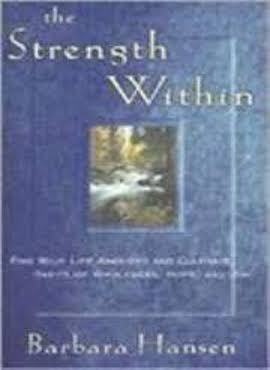
This book by Barbara Hansen had a profound impact on me at a time when I was struggling so I am hoping it will be useful for you as well. With that in mind, I will highlight a few of my favorite parts of the book.

First, however, I think the author’s back story is important. She was paralyzed at 19 years old and spent the rest of her life in a wheelchair. She describes some of her challenges including getting out of bed every morning using an elaborate hoisting method. Then she loses her home in a storm. So she is very qualified to discuss overcoming adversity.

Internal Resources

Hansen’s main focus is on developing internal resources to handle life’s difficulties. She talks about creating a “steel core of spiritual strength. There are three important first steps she discusses: 1) Process the pain of the past 2) Choose our response to reality 3) Stop making ourselves victims. She says, “By changing our thoughts and attitudes we can modify our actions, habits.” This way we gain inner strength.

What I find interesting is that she does not tell you what attitudes you should have and says this depends on the individual as long as it “nourishes the soul and makes us better people.”

She says, “Memorizing inspirational and peaceful lines from poetry or scripture has given me the inner strength to get through life’s lousy times.” This is good advice. It does take a little bit of work to do the memorization, but it is worth it.

We All Count

Hansen quotes William George Jordan, in his book, “The Majesty of Calmness.” Jordan says, “ Man’s unconscious influence, the silent subtle radiation of his personality, the effect of his words and acts, the trifles he never considers, is tremendous. Every moment of life is changing to a degree the life of the whole world.” Consider that last statement! Every moment of your life is effecting the whole world! That is such an uplifting and serious thought. We all count.

Death, divorce, aging, being single are all reasons for feeling what Hansen calls, “terminally alone.” She calls for all of us to become aware and be the person for someone who feels alone.

Journaling and Books

Hansen doesn’t specifically discuss journaling, but she talks about “typing.” Here is what she says, “ At the end of the day I will often know that life is not right; something’s wrong. Having only this vague sense of discontent, I’ll not be sure exactly what I am feeling or why I am feeling it, but I know something is corrupting my peace of mind. Typing helps me pull my emotions outside of myself and place them onto the screen. The longer I type the clearer my feelings and ideas become, my paper psychiatrist has helped me face, sift through, and deal with the emotional pain that has periodically pounded my life. As thing gives form and focus to my ideas and feelings, I find I am no longer in the clutches of discontent. Talking to my paper psychiatrist gives me a clear awareness of what it feels like to be me.” She says this so much better than I did in my book, but it is one of four things that helped me deal with adversity. I called it journalling and she calls it typing, but it is the same.

She says books give her strength and pleasure. “The insights and inspiration I get from books “refill my pitcher” when my pitcher gets empty.” So grab a book. It can make a difference.

Faith

Hansen says that “faith in God gives us a desire not only to live but to live well unless we believe being alive makes the world a better place, we are going to have a hard time getting in touch with our spiritual core; unless we have faith in our own uniqueness, we’ll find it difficult to to have faith in a power higher than ourselves.”…”This faith in our personal spiritual value gives us staying power when life hands us rotten reality.”

I love the final sentence in her book after she discusses the importance of spirituality as an anchor in everyone’s life and the hope it gives us. Then she says, “This hope isn’t the certainty that life will turn out well; it’s the belief that life makes sense regardless of how it turns out.”

Filed Under: Bookish Weapons, Ideas to Stay on Offense Tagged With: adversity, belief, emotions, life, overwhelm, pain, purpose, self-help, struggle

Bookish Weapon Number Twenty-Three

December 7, 2019 by Bill Montgomery Leave a Comment

Do you want to make better decisions and respond appropriately in more situations? Then this Elizabeth Stanley’s book, “Widen the Window,” is for you. It is a weapon you need in your arsenal.

This is a 400-page book so to pick one idea is pretty much impossible. So I won’t do that. I am going to give you the basics.

Basic Knowledge

Stanley asks that you read the first part of the book before reading her “solutions.” This makes sense because you need to be motivated to use what she suggests. She developed a course called MMFT or for short M-Fit and the book is mostly about the scientific and intellectual concepts that undergird this course. With that in mind, let’s continue.

She says that her “…window of tolerance to stress arousal was adaptively wired in response to my early social environment. It was narrowed during exposure to prolonged stress and trauma without adequate recovery.” Stanley had a tough childhood and then had more difficult times in the military which she discusses in the book.

We have two brains. The survival brain and the thinking brain is what Stanley calls them. They usually fight. It is not good when they fight with each other. The “thinking brain” engages in top-down processing which includes cognitive responses to things. It memorizes and learns stuff. Got it? The “survival brain” is “bottom-up processing.” “One of the survival brain’s most important functions is neuroception, an unconscious process of rapidly scanning the internal and external environment for opportunities/safety/pleasure and threats/danger/pain.” Its memory and learning system is “implicit.”

One of her main coping strategies was “suck it up and move on.” Some people have addictions or adrenaline-seeking behavior, disordered eating and a whole host of other things like isolation. She says these dynamics affect all of us and …they’re shared by anyone who fails to recalibrate their mind-body system after a distressing or traumatic event, such as a flood, car accident, or loss of a job or loved one. They are also shared by anyone who habitually over tenses their mind-body system during prolonged stress without adequate recovery, such as crashing to meet a deadline or working long hours over an extended period without some days off.”

Our childhood affects how wide our window is and works as a negative stressor as an adult. Even in daily life. She cautions that “By understanding how stress and trauma are a continuum, we can see how we might devalue things that are extremely stressful for the survival brain but “not that bad” to the thinking brain.” But, “…the survival brain believes the traumatic event was never complete.”

You might have a mind-body system that unconsciously craves a crisis. That’s not good

There is a lot more basic knowledge, but this gives you a decent look.

The Fix

Stanley wants us “to use our biology in a new way. By systematically training our attention, we can widen the window within which our thinking brain and survival brain work together cooperatively.”

She gives us two exercises to do. The first one, called the “Contact Point Exercise,” involves sitting in a chair and getting a sense of how it feels, how it supports your body and then you notice all the contact points of the chair with your body. You scan your body for tightness or tension. See if the tension shifts. Then you bring the sensation back to physical contact with the chair and she says to pay attention to three areas: 1) between your legs, butt, and lower back and the chair; 2) between your feet and the ground and 3) where your hands are touching your legs or each other. Then pick one point where you feel most contact. Then direct and sustain your attention at that point. Just like meditation, if your attention wonders ring it back. Then after 5, 10, 15, 20 minutes notice your whole body and notice if anything has changed. Higher energy? Less or more tension? That’s the first exercise in a nutshell.

The second exercise she calls “Grounding and Release,” which is a lot like the first. Get yourself into a chair, bring your attention to your symptoms of stress activation (she has a whole list f these in the book). Pay attention to the physical sensations. Once you notice that you are “activated.” Then notice that contact point again with the chair. Keep your focus on the contact point until you feel release from the stress or “activation.”

The idea with this second exercise is to “…let the thinking brain be the survival brain’s ally, by disengaging attention from the stress activation and redirecting the attention towards stimuli that will facilitate the survival brain neurocepting safety.

Rest Of The Book

The rest of the book is more or less typical self-help information. It is interesting, but not as crucial as the above.

Filed Under: Bookish Weapons, Ideas to Stay on Offense Tagged With: adversity, Bookish Weapons, consequences, emotions, Health, meaning, overwhelm, pain, recovery, Stress

  • « Previous Page
  • 1
  • …
  • 7
  • 8
  • 9
  • 10
  • 11
  • …
  • 13
  • Next Page »

Live the Life You Deserve

* indicates required

Attacking Adversity

[the_ad id=”192″]

Recent Posts

More Book Summaries

It has been some time since I have done any book reviews here, but that will be changing. Also, hiking season is almost here so more pictures. I will be turning 80 in a few months so it should be … [Read More...]

Go Hiking And Build Your Best Life

Hiking for me is the best part of living the life I want. Being in nature, challenging my body, moving. If you hike you know it can become an important part of your life. At 78 I ask myself, “Will … [Read More...]

Bookish Weapon Number Seventy-Three

Arthur Brooks has written a book that not only includes useful advice but I really like the cover which includes mountains and someone (I imagine it is me) standing on top of one. What better … [Read More...]

Copyright © 2026 · Log in

X
Subject:
Message:
Ajax loader
Share with friends
Share on Twitter Share
Share
Share on Facebook Share
Share
Share on Linkedin Share
Share
Share on Reddit Share
Share
Share on Pinterest Share
Share
Share on Digg Share
Share
Share on Tumblr Share
Share
Share on Whatsapp Share
Share
Share on Weibo Share
Share
Share on Stumbleupon Share
Share
Share on Flipboard Share
Share
Share on Email Share
Share
Share on Print Share
Share