Stay on Offense Climb Mountains

Attacking Adversity

  • Keep Moving Forward
  • Go Hiking
  • Ideas to Stay on Offense
  • Bookish Weapons
  • About Bill Montgomery
    • Log In
    • Membership Account
    • 1-Time Donation
    • Contact Coach Bill
      • Thank You & FAQ
  • Facebook

Bookish Weapon Number Fifty-Six

June 12, 2021 by Bill Montgomery Leave a Comment

“The Attributes,” by Rich Diviney will teach you a lot about things you thought you already knew. Things that you can use in the fight. There were two examples in the book that took me by surprise. Accountability and Narcissism.

I focus first on these because I found them most interesting. After those I will look at some others.

Accountability

There are twenty-five Attributes in the book, so why start with this one? It is because discovered I was very low in it. I thought I understood what it meant, but then Diviney explained that one of the things that someone who is accountable doesn’t do is be a mediator.

He explains by saying that someone who is a mediator will get an order from the boss and then go tell his subordinates that this is the new order and he doesn’t necessarily agree with it but it is whet the boss wants. That is being a mediator and is bad. You should rather own that order like it was your own.

Narcissism

My first reaction was that you would not want a Narcissist on your team, but I was wrong.

The author points out that everybody has a degree of narcissism in them and a certain amount of it is a good thing. It is only when it gets out of hand that it becomes a negative. You need a decent dose of it to get yourself to take on a challenge. Otherwise you wouldn’t try.

Resilience

The best story in the book is the one about Hank. He lost both his legs in war. When he wakes up in the hospital and realizes he has no legs he says to himself, ”I’m going to be fine. Grab the paper towels.” Apparently his mother had taught him not to cry over spilt milk. He had dropped a bottle of milk and it splattered all over the floor. His mother told him to “Get the paper towels.” That stuck with him.

If you are high in resilience then maybe you would react like Hank. Hank also says, “Getting over the little tragedies in daily life is how you get over the big tragedies.” He says he became resilient before he lost his legs.

Discipline

You probably think you know all about discipline. You read Jocko Willink’s book “Discipline Equals Freedom.” You didn’t, well read it then. Anyway, I thought there was just one kind of discipline, self-discipline. It turns out I was wrong again. Diviney explains that self-discipline is not eating the cookie, overcoming emotions and weaknesses, but discipline is about “accomplishing external goals.”

The other thing is that self-discipline is a skill and discipline is an attribute! As he says, “Discipline is the determined ability to remain focused until goals are accomplished.” That is huge. I never realized the difference for some reason.

Conscientiousness

Ok, this is the last one. I don’t need to re-write the book. However, Diviney tells another story about a man named Chris that displayed this characteristic. It is “an amalgam of traits and behaviors. Persistence, thoroughness, and predictability are key parts of a conscientious personality, as are resourcefulness, energy, and planning.”

Chris was a Navy SEAL going through BUDs. Divine says he volunteered for everything. He was always looking to do more. In his childhood he learned that you should always be looking to help. This carried into adulthood. His philosophy served him in civilian life as well when he became a SWAT team commander. His men figured, “If the boss is always looking for something to do, the theory goes, maybe I should too.”

Remember, there are 25 attributes in the book. Don’t miss ay of them. Read it!

Filed Under: Bookish Weapons, Ideas to Stay on Offense Tagged With: adversity, belief, emotions, life, meaning, resilience, self-help, struggle, success

Bookish Weapon Number Fifty-Five

May 8, 2021 by Bill Montgomery Leave a Comment

Is “Beyond Order” a Bookish Weapon? Of course it is, because in gives you more tools to fight adversity. Most of these tools are concerning how you think about things. They are structured in twelve rules about life.

Let’s look at the first rule in the book which is “Do not Carelessly Denigrate Social Institutions Or Creative Achievement.” Of course Jordan makes a comprehensive argument as to why you should not do this. There are eleven more rules like this. Actually there are many more rules, but you need to read his first book for those.

Rule 1

In this summary of the book I am not going to spend lots of time on each rule, but I think I need to briefly discuss each one. Well, no! So I will just convey what I liked the most about a few of them or the most interesting ideas from my perspective.

The first tidbit I came across was when Peterson says that his experience from years of psychological practice taught him that “people depend on constant communication with others to keep their minds organized.” That observation is fascinating to me since I spend most of my time alone.

The second thing that got my attention was on page nine. He lists a series of questions he asks his clients such as “Do they have friends and a social life? A stable and satisfying intimate partnership?” And on and on. Based on my answers to the questions I am “insufficiently embedded in the interpersonal world and in danger of spiraling downward psychologically because of that.” That was not encouraging.

Rule 2

The second rule is “Imagine Who You Could Be and then Aim Single-Mindedly At That.” Two points noticed. He says, “By accepting life’s suffering therefore evil maybe overcome,” and “That which you most need to find will be found where you least wish to look.” He goes on to discuss Harry Potter and how that whole story fits in to all this.

Finally, he says, “You need to know where you are, or you will not be able to draw a straight line from your starting point to your destination. You need to know where you are going, or you will drown in uncertainty, unpredictability, and chaos, and starve for hope and inspiration.” That really sounds like my life, at least from time to time.

Rule 3

“Do Not Hide Unwanted Things In The Fog.” In this chapter he discusses things like “willful blindness,” and “Failing to look under the bed when you strongly suspect a monster is lurking there is not an advisable strategy.” That is so good!

He talks about what the fog actually is. “You have become distrustful even of hope itself, as your hope has been repeatedly shattered (and that is the very definition of hopelessness). You are afraid of yourself and other people. You are in the fog. “Imagine. More precisely, that you are so afraid that you will not allow yourself even to know what you want.”

Rule 4

“Notice That Opportunity Lurks Where Responsibility Has Been Abdicated.” (Ok, this one and maybe one more rule) Here Peterson discusses Peter Pan. He says that Peter has come to some conclusions like not wanting to grow up. “Better to remain king of the Lost Boys. Better to remain lost in fantasy with Tinkerbell, who provides everything a female partner can provide – except that she doesn’t exist.”

“You must sacrifice something of your manifold potential in exchange for something real in life. Time at something. Discipline yourself. Or suffer the consequence.And what is the consequence? All the suffering in life, with none of the meaning. Is there s better description of hell?”

And what about “willful blindness”mentioned earlier? He says, “It is a terrible temptation, as it allows for the sequestration into the future the trouble we face today. That would are fine if trouble did not compound, like interest – but we all know it does.”

There is so much more. Please read the book!!

Rule 11

Yes, I know, I skipped a bunch of rules, but I am not trying to rewrite the book. Rule eleven is “Do Not Allow Yourself To Become Resentful, Deceitful, or Arrogant.” I have so much underlined here it is hard to choose what to share.

I think this plea summarizes this rule: “Perhaps you could live in a manner who’s nobility, grandeur, and intrinsic meaning would be of sufficient import that you could tolerate the negative elements of existence without becoming so bitter as to transform everything around you into something resembling hell.”

Now, go get the book!

Filed Under: Bookish Weapons, Ideas to Stay on Offense Tagged With: adversity, Bookish Weapons, emotions, feelings, meaning, self-help, struggle

Go Hiking and Control The Chatter

April 22, 2021 by Bill Montgomery Leave a Comment

In the adjacent book review I left one important thing out that is brought up in the book. The importance of getting into “nature” to help you take control of the Chatter. The author discusses enjoying a sunrise as “soft fascination” as opposed to voluntary attention. Voluntary attention can be exhausted. He says nature draws our involuntary attention because it is “rife with soft fascinations.”

There were studies done on this that the author discusses and you can read the book if you need more proof. One is mentioned below. Nature reduces rumination. Isn’t the amazing?

Climb a Mountain and Control the Chatter

Just climbing a mountain helps you to keep rumination at bay. Less negative chatter enters your mind when you hike. I knew it made a difference but I had never seen anything to validate my view.

One of the things I find myself doing while hiking is repeating mantras. It keeps me going and is like a meditation. Then when the sun comes up it is so awe inspiring.

Studies

One study that was done in 2016 had one group of people watch a video of streets with no trees and another watch one with trees. The ones that were exposed to the “most views of nature showed a 60 percent increase in their ability to recover from the stress…”

So if you can watch a video and chill out then getting out in the woods will be even better! Now there is no excuse to not get our in nature.

Conclusion

The author says, “Collectively the findings demonstrate that nature provides humans with a tool for caring for our inner voice from the outside in, and the longer we are exposed to nature, the more our health improves.”

Go hiking!

Filed Under: Go Hiking, Keep Moving Forward Tagged With: adversity, focus, hiking, meaning, mountain, self-help, Stress, struggle

Bookish Weapon Number Fifty-Three

February 21, 2021 by Bill Montgomery Leave a Comment

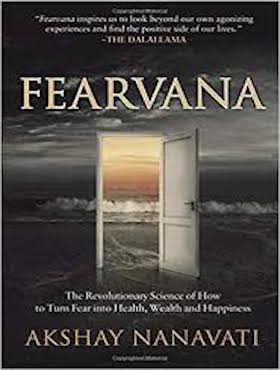
Author Akshay Nanavati has written a bookish weapon without him even realizing it. That’s ok. What a bookish weapon it is! In his introduction this former Marine sets the tone for the book. He says, “we all do the best we can with the level of skills, abilities, knowledge and awareness we possess at any given time.” He credits Jack Canfield for this, but follows it up by saying, “Any time you might be feeling confused, lost, or scared, it is not your fault.” Akshay also hikes! Actually he is a mountaineer which is far more impressive.

What is “Fearvana?” It is when you feel the fear or anxiety, then take action and you succeed. He give es the example of getting all nervous and afraid before going on stage, but then running out onto the stage and knocking it out of the park. That’s Fearvana.

Why Do We Do The Things We Do?

This is the title of chapter two. In it the author describes seven reasons for our actions. A couple of these stood out to me, but you should read the book because the others are important too.

The two that I enjoyed were “The Law of Love and Hate,” and “The Top-of-Mind Rule.” The first is a name he gives the filter of our animal brain. “It states that our gut feelings of love and hate determiner decisions and our views of the world.” The second is explained this way: “The easier it is to recall something from memory, the more likely our brain deems it important or commonplace…Whatever is on top of your mind is more likely to have an impact on your perception of reality.”So what can you do about all this? Akshay says, “By utilizing your human brain to make conscious decisions, you can literally change the physical structure and functions of your animal brain. Your cognitive biases won’t disappear, but you can change the way they operate for you.”

Real Freedom

The author believes that our only real freedom consists of our “ability to separate ourselves from suffering to create our own empowering reality.” So he says, “..it does not matter what you might be struggling with or how it might compare to other people’s suffering. Don’t waste your time and energy in the destructive downward spiral of second dart syndrome.” And what is the “second dart syndrome?” It is from Buddhist philosophy that says when we experience pain or suffering, it is the result of two darts. “First darts are the ones beyond our control…Second darts are the manner in which we react and respond to the first ones.”

It is all internal. “What we do inside our minds, the conversation we have with ourselves, that is what shapes our reality. Our mindset determines how much we suffer.You have the power and the freedom to choose how you interpret the world. That interpretation will control the quality of your life. If you don’t exercise this freedom, your brain will create its own interpretations without your awareness.”

LMNOP

Easy to remember, right? I liked it too. Of course, each of those letters stand for something. When something negative happens and you feel an emotion use these. L-label and language. Label the emotion to release yourself from the impact. M-Find the meaning you have attached to the event or emotion. You control the meaning. N – It’s not you. It’s your brain. You are just stuck in a pattern. “It is not who you are.” I guess N is for “Not.” O – Opt out for a more empowering meaning. Give the emotion or event or both a new meaning, P- Purpose and Preemptive strikes. The important thing in this step is to the action . Do something different the before. It builds new brain patterns.

LMNOP is a great tool for helping you get past an experience or emotion.

Changing Your Past Memory

He discusses how to change a past negative memory. Get yourself in a positive state, and then “going into you past, you can change the effect the past has on you today.” This was most interesting. This is all under a section called. “Your Past Is A Lie.” You need to do this in a six hour window. So “to change the past we need to activate a memory from an optimistic present state and modify it within six hours. Your past helped shape the fears that keep you imprisoned in your present, so altering your memories is often a necessary step to move from fear to Fearvana.”

Get the book for the complete process.

Positive Suffering

That’s my title. The author talks a lot about suffering and says, “Unending bliss awaits us within the simplicity of going to war with ourselves.” He says, “…people with high levels of stress without depression are some of the happiest people in the world. They are also the people who are most likely to view their lives as meaningful.” He stresses the need to prime your subconscious mind to embrace struggle.

I like what he suggests when you face a challenge. He says to ask, “What is fun about this? How can I make this enjoyable?” “Visualizing the process of struggle, as opposed to the outcome on the other side of it, better prepares you to overcome the struggle.”

That’s a quick look at the book. I didn’t even tewl you about the section entitled “The Most Important Habit Of All.” Get the book and read about it!

Filed Under: Bookish Weapons, Ideas to Stay on Offense Tagged With: adversity, Bookish Weapons, emotions, fear, meaning, preparation, self-help, success, visualization

Bookish Weapon Number Fifty-One

January 10, 2021 by Bill Montgomery Leave a Comment

My father was a serial entrepreneur. He owned at least six businesses that I know about during his lifetime. This is the ultimate entrepreneur’s book. “Built to Serve,” by Evan Carmichael is for those that want to find their purpose and become the leader they were born to be according to the subtitle. I would say that it delvers.

If you want to have your own business and use the Internet (especially Youtube) to generate business Evan is your guy.

Purpose

Before you can serve anyone you need to know your purpose. Evan presents you with excellent questions to ask yourself. He says your purpose is your “source of power.” He takes you through a process to discover your purpose.

You discover the who, the why and the how. First is your who. Who are you? Then you discover your why. Why do you want to do this? Finally, how are you gong to do it.

Your Who

Evan says that your “Who” is the starting point for everything. You start by figuring out what makes you happy. He gives you an excellent exercise for discovering this but he has also written another book called “Your One Word,” that he says will help even more.

In Built to Serve he presents you with five questions to help you discover your who.

Who was your favorite teacher growing up?
What is your favorite movie of all time?
What do you love most about how your parents raised you?
Which successful person do you look up to and why?
What lessons do you want your kids to have?

So once you have discovered your who and your core value, what then?

Your Why

Your why equals your purpose. It comes from your pain. I thought this was very enlightening. He says the way you turn the pain into something good “…is to turn that negative situation into a life-changing gift for yourself and others, to live a service life instead of a surface life, to give yourself a powerful reason to wake up in the morning and work on building something better for yourself and the people around you.” He says, “Your job is to face the pain, eat it, grow from it, and then create positivity and oxygen for others around you.”

Here is the difficulty which he attempts to answer and that is if you are still moored in the pain and have not yet overcome it then what good are you to someone else? He says, …”just the fact that you’re out there trying is an inspiration to others, and you also know more than you did when you started.”

Your How

You need to know how you saved yourself. Now if you haven’t done that then get busy. So you ask yourself, when did you decide something had to change? What is the first thing you did to start the change? Then How did you sustain the momentum? That is your recipe for success he says.

Your how is your passion. It is the work that you love. Evan says when you combine your Who with your Why with doing the work you love it is a hone run.

So don’t delay go get this book. It is one of the few books I have read that really could change your life if you are the right kind of person. Even if you don’t want to start a company it has some great insights about life in general. If fact, I would suggest you get it and read it twice.

Filed Under: Uncategorized Tagged With: Bookish Weapons, decisons, feelings, life, meaning, purpose, self-help, struggle, success

Bookish Weapon Number Fifty

December 20, 2020 by Bill Montgomery Leave a Comment

There are lots of books that urge you to put the phone down and get off of social media. Eldridge does that in this book, but it is much more than that. Eldredge writes for Christians or those that are intrigued by Christianity, However, there are ideas in this book for everyone.

Distraction is the currency of this time. Focus or relaxation is hard to come in today’s world. It takes conscious effort. John Eldredge helps us in his book, “Get Your Life Back.”

Questions

Eldredge asks us to score our soul by answering the following questions:

Are you happy most of the time?
How often do you feel lighthearted?
Are you excited about your future?
Do you feel deeply loved?
When was the last time you felt carefree?

All good questions. If you did nothing but sit down and answer these you would get a lot out of the book.

One Minute Pause

In this book, Eldredge introduces the One Minute Pause. He has an App that gives you a choice of one, five, or ten minutes to pause. He suggests you do it twice a day. I use the ten-minute version once a day myself and love it.

He says, “The one minute pause can be used in many ways: for prayer or silence, to find your heart again, or to enjoy a moment of beauty.” Think about this. Taking one, five, or ten minutes once or twice a day to calm yourself can make a huge difference in your life.

Detachment

You have probably at least read about detachment. Buddhist Monks discuss the importance of detachment, but I was a little surprised that a Christian writer would tout its benefits. However, Eldredge adds a qualifier. He calls it “Benevolent Detachment.” The benevolent part means kindness he says. So we detach from what is burdening us without being unkind to others. So no “cynicism or resignation.” As Eldredge says, it is “something done in love.”

Eldredge goes on to discuss how God calls us to a carefree life. He sites a book I have reviewed here called, “The Subtle Art of Not Giving a F*ck,” in which the author makes the case that you “can’t care about everything all the time.”

Drinking Beauty

This is the title of one of his chapters. I love it because he talks about nature. Eldredge is a fisherman and a game hunter who does a lot of hiking and climbing too I believe. Nature offers beauty to everyone.

St Augustine described it as “a plank in the waves of the sea.” “Beauty rescues,” says Eldredge. I was so happy to read this because it validates what I knew to be true by spending so much time hiking myself.

As usual, there is so much more in the book. A chapter on being kind to yourself and a chapter on spending time outdoors! So buy it! Read it!!

Filed Under: Bookish Weapons, Ideas to Stay on Offense Tagged With: Bookish Weapons, feelings, focus, hiking, life, meaning, purpose, self-help, spiritual

  • « Previous Page
  • 1
  • 2
  • 3
  • 4
  • …
  • 6
  • Next Page »

Live the Life You Deserve

* indicates required

Attacking Adversity

[the_ad id=”192″]

Recent Posts

More Book Summaries

It has been some time since I have done any book reviews here, but that will be changing. Also, hiking season is almost here so more pictures. I will be turning 80 in a few months so it should be … [Read More...]

Go Hiking And Build Your Best Life

Hiking for me is the best part of living the life I want. Being in nature, challenging my body, moving. If you hike you know it can become an important part of your life. At 78 I ask myself, “Will … [Read More...]

Bookish Weapon Number Seventy-Three

Arthur Brooks has written a book that not only includes useful advice but I really like the cover which includes mountains and someone (I imagine it is me) standing on top of one. What better … [Read More...]

Copyright © 2026 · Log in

X
Subject:
Message:
Ajax loader
Share with friends
Share on Twitter Share
Share
Share on Facebook Share
Share
Share on Linkedin Share
Share
Share on Reddit Share
Share
Share on Pinterest Share
Share
Share on Digg Share
Share
Share on Tumblr Share
Share
Share on Whatsapp Share
Share
Share on Weibo Share
Share
Share on Stumbleupon Share
Share
Share on Flipboard Share
Share
Share on Email Share
Share
Share on Print Share
Share