Stay on Offense Climb Mountains

Attacking Adversity

  • Keep Moving Forward
  • Go Hiking
  • Ideas to Stay on Offense
  • Bookish Weapons
  • About Bill Montgomery
    • Log In
    • Membership Account
    • 1-Time Donation
    • Contact Coach Bill
      • Thank You & FAQ
  • Facebook

Bookish Weapon Number Seventy-Three

December 10, 2023 by Bill Montgomery Leave a Comment

Arthur Brooks has written a book that not only includes useful advice but I really like the cover which includes mountains and someone (I imagine it is me) standing on top of one.

What better backdrop to a book entitled “Build The Life You Want.” With the mountains on the cover he didn’t even need a subtitle.

Happier

Brooks is a “happiness” researcher. He knows all about it and says although you can’t “be happy” you can be “happier.” That’s good. Brooks says everyone thinks the can be happy but their circumstances are keeping them stuck in unhappiness.

He goes to say happiness is not a destination but rather a direction. He says, “You can get happier, even if you have problems. You can even get happier in some cases because you have problems.” I like that a lot.

What is it?

First Brooks discusses what Epictetus, Stoic philosopher thought about happiness or its definition. He said he “believed happine ss comes from fining life’s purpose, accepting one’s fate and behaving morally regardless of personal cost.”

In nutrition experts talk about macronutrients and micronutrients. Well, Brooks says there are three macronutrients that you need in abundance in your life: enjoyment, satisfaction and purpose. And points out that all three have some “unhappiness” in them. For example satisfaction requires sacrifice. “…when we are sad or angry about something, we may be more likely to fix it.”Then he gives you a test of sorts where you determine “your unique mix of happiness and unhappiness.” Then he labels you a cheerleader, a mad scientist, a judge or a poet. Read the book and find out what you are!

And So

To much good feeling is sometimes not so good because you don’t see a threat. It is better to have a mix. Brooks says, “The secret to the best life is to accept your unhappiness (so you can learned grow) and manage the feelings that result.” Oprah says, “Feel the feel then take the wheel.”

What you need is metacognition. An example is counting to ten when your angry. The folks at Heroic would call this reactive discipline. Brooks says it gives your prefrontal cortex time to catch up to your limbic system. Take thirty seconds to imagine what the consequences will be if you day what you are thinking of saying.

Tools

If you can’t change things change how you are experiencing them. If you ruminate, blame yourself, take drugs or alcohol it is not productive. Those things can make everything worse. Like Jordan B. Peterson is fond of saying, “No matter how bad things are you can always make them worse.” So how do you handle it? Metacognition!

I think the author says it better than I can paraphrase: “Metacognition offers a better, healthier, and more permanent solution. Consider the emotions that your circumstances are stimulating in you. Observe them as if they’re happening to someone else, and accept them. Write them down to make sure they are completely conscious. Then consider how you can choose reactions not based on your negative emotions, but rather based on the outcomes you prefer in your life.”

There is an entire section on happiness at work and a chapter in faith and mindfulness. He finally urges you to teach what you learned from the book and this short piece is my attempt to do that.

Filed Under: Bookish Weapons, Ideas to Stay on Offense Tagged With: adversity, Bookish Weapons, emotions, overwhelm, self-help, struggle

Bookish Weapon Number Fifty-Seven

July 11, 2021 by Bill Montgomery Leave a Comment

Garrett White is the author of “WarriorBook.” I was introduced to it by enrolling in his challenge, which was very useful for me. Check out Wake Up Warrior online. He focuses on those men who have a business and family. He helps them have it all in Body, Being and Balance. It sure is a bookish weapon!

So what is the WarriorBook all about? First of all it is 512 pages long so I am only going to touch the surface of this monster. It spends a lot of time discussing “The Pit.” The pit is where you are when things are not going so well. He also talks a lot about the Drift and Shift model. Then he discusses “The Core,” “The Keys,” and “The Game.”

The Pit

Garrett says that “At some point you will find yourself in the Pit of Despair playing the Sedation game. Your Liberation will come through your ability to hear and act on the Voice inside of you.” This is a whole chapter discussing boredom and burnout, and Garrett’s own experience in the Pit. He gets pretty real including fights with his wife, divorces and financial problems.

I liked his explanation of “Sedation,” which is using alcohol, drugs or whatever to numb yourself. I thought “sedation” was an excellent term for this.

Men

This is a book for men and about men. Here is a quote from the book that will gibe you an idea about where he is coming from. He is talking about the depolarization of couples and one of his points is “We don’t even know what being a man is anymore because everywhere we turn men are being disappointed, disjointed, and disconnected. They’re being told, “Shut up, go get the money, don’t talk about your feelings, and just so you know, we don’t need you because we are the same.”

So Garrett got things rolling with the Warrior programs. He figured he was the one that needed to do it. To give men a chance to have it all.

Questions

Here are some questions Garrett has you answer that might just help you sort things out a a man:

Is your life working?
What does living mean?
What does it mean for me to ultimately have it all?
What do I want my life to look like?
What do I want as a man?
Are you ready to pay the necessary price?

Body, Being, Balance, Business

One of the things Garrett hits hard is the importance of hitting your four “Core.” These are the above. Body – Fitness plus fuel (diet and exercise), Being – Meditation and Focus, Balance – Partner/Posterity, Business – Discover and Declare.

Then he says ask more questions:
Am I winning? Am I winning the game of life? Is it worth it to play? (Huge question) What are the targets I am searching to hit today, this week, this month, this quarter? How do I know I am winning? How do I simplify my life down to a game of metrics?

This book is available on audio I think. However, a search on Amazon does not turn it up. You might have to take one of his challenges to get it.

Filed Under: Bookish Weapons, Ideas to Stay on Offense Tagged With: adversity, Bookish Weapons, emotions, exercise, overwhelm, pain, self-help, struggle

Go Hiking and Get Your Life Back

December 20, 2020 by Bill Montgomery Leave a Comment

So you ask me, “How does that work?” Well, if you have been reading these odes to the mountains you will understand that is the easiest task. All it takes is a few hikes and your life changes.

How does it change? First, you go hiking. Before you went hiking you were so distracted by emails, Instagram, Tik Tok, and even Microsoft teams that you had lost your life. It had disappeared into the electronic Matrix. Once you get on the trails things settle down.

The Matrix

You might think that when you are looking at your phone instead of looking at the person across from you that you have your life firmly in hand. Or you are supposed to be exercising but you are sitting on a bench at the gym staring at your phone.

Your mind is in a Matrix composed of all the lures of the electronic universe. You have to escape it to see it for what it is, an addiction so heinous that it will grind you up and spit you out into a pile of wasted lives.

Busyness

Oh, you say that you have your phone under control and you are in charge of it. But you are going from one meeting to another, rushing from one office to another, catching a plane, a lunch date, or grabbing a bite on the run. You have lost your life in the busyness of it.

How long has it been since you had time, even ten minutes to sit and think? A long time I imagine.

The Solution

The best solution is to go hiking! Put your phone in your pack and only take it out to take a picture when you get to the top of a mountain. If you need to take a picture before you reach the top then you still need to keep it in your pack. Make it hard to get at.

Then you hiking, with trees surrounding you and the odor of pine needles or will strawberries wafting up to you. The breeze is on your face. You relax as you push yourself forward. You become one with nature. You get your life back.

A Little More

Maybe a quote from one of Eldredge’s other books, Epic. He says, “We have grown dull towards this world in which we live; we have forgotten that it is not normal or scientific in any sense of the word. It is fantastic. It is a fairy tale through and through. Really now. Elephants? Caterpillars? Snow? At what point did you lose your wonder at it all?” “Perhaps we come upon a waterfall, clouds have made a rainbow in a circle around the sun…”

Go hiking, experience it all (maybe not Elephants), and get your life back!

Filed Under: Go Hiking, Keep Moving Forward Tagged With: exercise, Health, hiking, overwhelm, purpose, self-help, success

Bookish Weapon Number Twenty-Four

December 14, 2019 by Bill Montgomery Leave a Comment

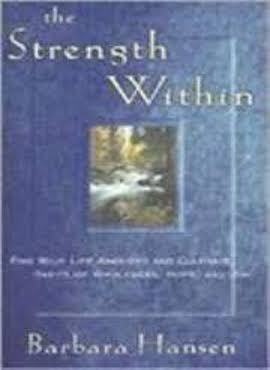
This book by Barbara Hansen had a profound impact on me at a time when I was struggling so I am hoping it will be useful for you as well. With that in mind, I will highlight a few of my favorite parts of the book.

First, however, I think the author’s back story is important. She was paralyzed at 19 years old and spent the rest of her life in a wheelchair. She describes some of her challenges including getting out of bed every morning using an elaborate hoisting method. Then she loses her home in a storm. So she is very qualified to discuss overcoming adversity.

Internal Resources

Hansen’s main focus is on developing internal resources to handle life’s difficulties. She talks about creating a “steel core of spiritual strength. There are three important first steps she discusses: 1) Process the pain of the past 2) Choose our response to reality 3) Stop making ourselves victims. She says, “By changing our thoughts and attitudes we can modify our actions, habits.” This way we gain inner strength.

What I find interesting is that she does not tell you what attitudes you should have and says this depends on the individual as long as it “nourishes the soul and makes us better people.”

She says, “Memorizing inspirational and peaceful lines from poetry or scripture has given me the inner strength to get through life’s lousy times.” This is good advice. It does take a little bit of work to do the memorization, but it is worth it.

We All Count

Hansen quotes William George Jordan, in his book, “The Majesty of Calmness.” Jordan says, “ Man’s unconscious influence, the silent subtle radiation of his personality, the effect of his words and acts, the trifles he never considers, is tremendous. Every moment of life is changing to a degree the life of the whole world.” Consider that last statement! Every moment of your life is effecting the whole world! That is such an uplifting and serious thought. We all count.

Death, divorce, aging, being single are all reasons for feeling what Hansen calls, “terminally alone.” She calls for all of us to become aware and be the person for someone who feels alone.

Journaling and Books

Hansen doesn’t specifically discuss journaling, but she talks about “typing.” Here is what she says, “ At the end of the day I will often know that life is not right; something’s wrong. Having only this vague sense of discontent, I’ll not be sure exactly what I am feeling or why I am feeling it, but I know something is corrupting my peace of mind. Typing helps me pull my emotions outside of myself and place them onto the screen. The longer I type the clearer my feelings and ideas become, my paper psychiatrist has helped me face, sift through, and deal with the emotional pain that has periodically pounded my life. As thing gives form and focus to my ideas and feelings, I find I am no longer in the clutches of discontent. Talking to my paper psychiatrist gives me a clear awareness of what it feels like to be me.” She says this so much better than I did in my book, but it is one of four things that helped me deal with adversity. I called it journalling and she calls it typing, but it is the same.

She says books give her strength and pleasure. “The insights and inspiration I get from books “refill my pitcher” when my pitcher gets empty.” So grab a book. It can make a difference.

Faith

Hansen says that “faith in God gives us a desire not only to live but to live well unless we believe being alive makes the world a better place, we are going to have a hard time getting in touch with our spiritual core; unless we have faith in our own uniqueness, we’ll find it difficult to to have faith in a power higher than ourselves.”…”This faith in our personal spiritual value gives us staying power when life hands us rotten reality.”

I love the final sentence in her book after she discusses the importance of spirituality as an anchor in everyone’s life and the hope it gives us. Then she says, “This hope isn’t the certainty that life will turn out well; it’s the belief that life makes sense regardless of how it turns out.”

Filed Under: Bookish Weapons, Ideas to Stay on Offense Tagged With: adversity, belief, emotions, life, overwhelm, pain, purpose, self-help, struggle

Bookish Weapon Number Twenty-Three

December 7, 2019 by Bill Montgomery Leave a Comment

Do you want to make better decisions and respond appropriately in more situations? Then this Elizabeth Stanley’s book, “Widen the Window,” is for you. It is a weapon you need in your arsenal.

This is a 400-page book so to pick one idea is pretty much impossible. So I won’t do that. I am going to give you the basics.

Basic Knowledge

Stanley asks that you read the first part of the book before reading her “solutions.” This makes sense because you need to be motivated to use what she suggests. She developed a course called MMFT or for short M-Fit and the book is mostly about the scientific and intellectual concepts that undergird this course. With that in mind, let’s continue.

She says that her “…window of tolerance to stress arousal was adaptively wired in response to my early social environment. It was narrowed during exposure to prolonged stress and trauma without adequate recovery.” Stanley had a tough childhood and then had more difficult times in the military which she discusses in the book.

We have two brains. The survival brain and the thinking brain is what Stanley calls them. They usually fight. It is not good when they fight with each other. The “thinking brain” engages in top-down processing which includes cognitive responses to things. It memorizes and learns stuff. Got it? The “survival brain” is “bottom-up processing.” “One of the survival brain’s most important functions is neuroception, an unconscious process of rapidly scanning the internal and external environment for opportunities/safety/pleasure and threats/danger/pain.” Its memory and learning system is “implicit.”

One of her main coping strategies was “suck it up and move on.” Some people have addictions or adrenaline-seeking behavior, disordered eating and a whole host of other things like isolation. She says these dynamics affect all of us and …they’re shared by anyone who fails to recalibrate their mind-body system after a distressing or traumatic event, such as a flood, car accident, or loss of a job or loved one. They are also shared by anyone who habitually over tenses their mind-body system during prolonged stress without adequate recovery, such as crashing to meet a deadline or working long hours over an extended period without some days off.”

Our childhood affects how wide our window is and works as a negative stressor as an adult. Even in daily life. She cautions that “By understanding how stress and trauma are a continuum, we can see how we might devalue things that are extremely stressful for the survival brain but “not that bad” to the thinking brain.” But, “…the survival brain believes the traumatic event was never complete.”

You might have a mind-body system that unconsciously craves a crisis. That’s not good

There is a lot more basic knowledge, but this gives you a decent look.

The Fix

Stanley wants us “to use our biology in a new way. By systematically training our attention, we can widen the window within which our thinking brain and survival brain work together cooperatively.”

She gives us two exercises to do. The first one, called the “Contact Point Exercise,” involves sitting in a chair and getting a sense of how it feels, how it supports your body and then you notice all the contact points of the chair with your body. You scan your body for tightness or tension. See if the tension shifts. Then you bring the sensation back to physical contact with the chair and she says to pay attention to three areas: 1) between your legs, butt, and lower back and the chair; 2) between your feet and the ground and 3) where your hands are touching your legs or each other. Then pick one point where you feel most contact. Then direct and sustain your attention at that point. Just like meditation, if your attention wonders ring it back. Then after 5, 10, 15, 20 minutes notice your whole body and notice if anything has changed. Higher energy? Less or more tension? That’s the first exercise in a nutshell.

The second exercise she calls “Grounding and Release,” which is a lot like the first. Get yourself into a chair, bring your attention to your symptoms of stress activation (she has a whole list f these in the book). Pay attention to the physical sensations. Once you notice that you are “activated.” Then notice that contact point again with the chair. Keep your focus on the contact point until you feel release from the stress or “activation.”

The idea with this second exercise is to “…let the thinking brain be the survival brain’s ally, by disengaging attention from the stress activation and redirecting the attention towards stimuli that will facilitate the survival brain neurocepting safety.

Rest Of The Book

The rest of the book is more or less typical self-help information. It is interesting, but not as crucial as the above.

Filed Under: Bookish Weapons, Ideas to Stay on Offense Tagged With: adversity, Bookish Weapons, consequences, emotions, Health, meaning, overwhelm, pain, recovery, Stress

Bookish Weapon Number Thirteen

August 24, 2019 by Bill Montgomery Leave a Comment

Today’s “Bookish Weapon” is not from a book so this is a rule breaker I suppose. It is from one of the authors discussed elsewhere, Jocko Willink. It is a quote from his podcast about suicide. I think it needs to be reproduced everywhere. I suppose it does not have the impact of hearing his booming voice, but the words are wisdom and may just save someone. Here it is in its entirety:

Powerful Antidote

“If you feel like life is in a place where you can’t get any lower and don’t think you can find any way out – Good! That means the ultimate challenge is ahead of you. You can only go up and it also means things are going to be tough. The storm you’re in from your perspective  seems like the storm is enveloping the whole world, but it is not. The storm you’re in – it is hard to see past it. The storm is everything, but it is not, and won’t last forever. You can get out of the storm and it will end and you will see sun again. Right now you are being tried. Forged and tested by fire and pain. Don’t fail the test! Don’t give in or quit! Fight through the pain and come out the other side stronger and tougher and better. A fighter! A survivor! A Winner! Victorious! Free from that storm. Free from the darkness!”

Use It

This was one of the best verbal “antidotes” I had ever heard for someone thinking about taking their life. Suicide is, as I write this, an epidemic among the military and young people. However, it touches all walks of life and ages. If you have lived very long you either know someone or know someone who knows someone that killed themselves. So share this with others. It is one more tool in your belt when fighting this kind of darkness. Use it!

Filed Under: Bookish Weapons, Ideas to Stay on Offense Tagged With: adversity, overwhelm, self-help, struggle, suicide

  • 1
  • 2
  • Next Page »

Live the Life You Deserve

* indicates required

Attacking Adversity

[the_ad id=”192″]

Recent Posts

More Book Summaries

It has been some time since I have done any book reviews here, but that will be changing. Also, hiking season is almost here so more pictures. I will be turning 80 in a few months so it should be … [Read More...]

Go Hiking And Build Your Best Life

Hiking for me is the best part of living the life I want. Being in nature, challenging my body, moving. If you hike you know it can become an important part of your life. At 78 I ask myself, “Will … [Read More...]

Go Hiking and See A UFO

Dirty Harry’s Peak is not a hike I look forward to every year, but it is a good challenge and great for conditioning your legs. Old legs need all the conditioning they can get. This year was no … [Read More...]

Copyright © 2026 · Log in

X
Subject:
Message:
Ajax loader
Share with friends
Share on Twitter Share
Share
Share on Facebook Share
Share
Share on Linkedin Share
Share
Share on Reddit Share
Share
Share on Pinterest Share
Share
Share on Digg Share
Share
Share on Tumblr Share
Share
Share on Whatsapp Share
Share
Share on Weibo Share
Share
Share on Stumbleupon Share
Share
Share on Flipboard Share
Share
Share on Email Share
Share
Share on Print Share
Share