Stay on Offense Climb Mountains

Attacking Adversity

  • Keep Moving Forward
  • Go Hiking
  • Ideas to Stay on Offense
  • Bookish Weapons
  • About Bill Montgomery
    • Log In
    • Membership Account
    • 1-Time Donation
    • Contact Coach Bill
      • Thank You & FAQ
  • Facebook

Go Hiking And Don’t Step On A Rattler

December 21, 2019 by Bill Montgomery Leave a Comment

Another hike from the bottom of the Grand Canyon, on the Colorado River that I was a part of, was a hair-raiser. These hikes were typically a 5 to 10-mile round trip and this particular one was no exception. It was designed to enable us to get the view you see in the picture above.

Snake!

One of the guides would not allow me to use my trekking poles which I liked, because my knees were much worse in 1998 than they are now. As it turned out, it was probably a good idea.

The hike began as a medium grade climb. Everyone lined up behind the guide. Part of me does not even like the idea of a “guide,” but in the Grand Canyon, you need one. They know the trails and dangers. Soon we came to a flatter area with low, dry bushes. We were just enjoying the desert scenery when the guide yells, “snake to your left.” Then he says, “Move slow but keep moving.” Nothing connects to your primal sense of survival as hearing that word. I looked to my left and just in front of me was the biggest rattlesnake I had ever seen. It was curled up and in the striking position, but it was asleep! Whew! So we all moved right on by with no problems.

Scorpions

The snake is not the only danger you face in this area. We were told at the very beginning of the trip to be sure to keep your boots inside your tent overnight. Otherwise, you might get a real surprise when you put them on the next morning. There is a clear or pale scorpion called centruroides that crawls around looking for shoes I guess. They only bite when defending themselves, but I guess if you try to crush them in your boot they might take that as an attack.

These pale scorpions are deadly. Here is a quote for you, “The estimated annual number of scorpion stings is 1.2 million leading to 3250 deaths (0.27%). For every person killed by a venomous snake, 10 are killed by a venomous scorpion.” However, I also read that these deaths have declined over the years.

So if you are climbing in the desert you need to be cautious. Still, don’t let them stop you! Go hiking!

Filed Under: Go Hiking, Keep Moving Forward Tagged With: adversity, danger, decisons, hiking, life, mountain, success

Go Hiking And Find The Strength Within

December 14, 2019 by Bill Montgomery Leave a Comment

No matter what difficulties I am facing from day to day, when I get up in the mountains I find a strength that I don’t have when I am not climbing. I think it is one of the ways I connect with my creator.

Of course, you are outdoors in creation. Being outside in the forest aligns with our nature as humans.

The Quiet

There are places in the mountains away from freeways and even the sound of waterfalls where you can hear your heartbeat. In these places, I am rejuvenated. I find the strength I didn’t know I had.

Having places like this gives me a place to rest. Resting when climbing mountains is typically not what I do. However, in these cases, I make an exception.

The Clouds

Am I the only person that finds strength in clouds? Especially in the mountains where they hide part of a view or make a landscape almost spooky.

Everyone has seen clouds take the shape of familiar things or scary things. You might see a dragon or an angel. Somehow, in the mountains, these images are more powerful and can transfer that power to the person watching.

The Trees

I know I have talked about being a tree hugger before this. The trees surround you and I suppose that is why you hear the term “nature bathing.” The large ones are so old. I read once that old trees talk. It is just that they talk so slow you can’t understand them.

Trees seem so much more stable than me. Rooted deep in the ground seemingly unmovable. And I think you can borrow some of that stability just by being around them.

The quiet, clouds and trees all combine to strengthen the spirit within. So go hiking!

Filed Under: Go Hiking, Keep Moving Forward Tagged With: adversity, emotions, hiking, mountain, self-help, strength, struggle, trees

Bookish Weapon Number Twenty-Four

December 14, 2019 by Bill Montgomery Leave a Comment

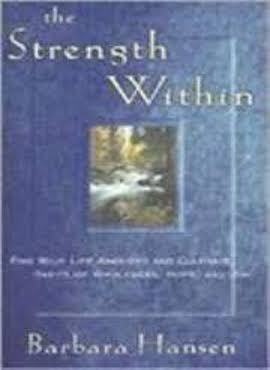
This book by Barbara Hansen had a profound impact on me at a time when I was struggling so I am hoping it will be useful for you as well. With that in mind, I will highlight a few of my favorite parts of the book.

First, however, I think the author’s back story is important. She was paralyzed at 19 years old and spent the rest of her life in a wheelchair. She describes some of her challenges including getting out of bed every morning using an elaborate hoisting method. Then she loses her home in a storm. So she is very qualified to discuss overcoming adversity.

Internal Resources

Hansen’s main focus is on developing internal resources to handle life’s difficulties. She talks about creating a “steel core of spiritual strength. There are three important first steps she discusses: 1) Process the pain of the past 2) Choose our response to reality 3) Stop making ourselves victims. She says, “By changing our thoughts and attitudes we can modify our actions, habits.” This way we gain inner strength.

What I find interesting is that she does not tell you what attitudes you should have and says this depends on the individual as long as it “nourishes the soul and makes us better people.”

She says, “Memorizing inspirational and peaceful lines from poetry or scripture has given me the inner strength to get through life’s lousy times.” This is good advice. It does take a little bit of work to do the memorization, but it is worth it.

We All Count

Hansen quotes William George Jordan, in his book, “The Majesty of Calmness.” Jordan says, “ Man’s unconscious influence, the silent subtle radiation of his personality, the effect of his words and acts, the trifles he never considers, is tremendous. Every moment of life is changing to a degree the life of the whole world.” Consider that last statement! Every moment of your life is effecting the whole world! That is such an uplifting and serious thought. We all count.

Death, divorce, aging, being single are all reasons for feeling what Hansen calls, “terminally alone.” She calls for all of us to become aware and be the person for someone who feels alone.

Journaling and Books

Hansen doesn’t specifically discuss journaling, but she talks about “typing.” Here is what she says, “ At the end of the day I will often know that life is not right; something’s wrong. Having only this vague sense of discontent, I’ll not be sure exactly what I am feeling or why I am feeling it, but I know something is corrupting my peace of mind. Typing helps me pull my emotions outside of myself and place them onto the screen. The longer I type the clearer my feelings and ideas become, my paper psychiatrist has helped me face, sift through, and deal with the emotional pain that has periodically pounded my life. As thing gives form and focus to my ideas and feelings, I find I am no longer in the clutches of discontent. Talking to my paper psychiatrist gives me a clear awareness of what it feels like to be me.” She says this so much better than I did in my book, but it is one of four things that helped me deal with adversity. I called it journalling and she calls it typing, but it is the same.

She says books give her strength and pleasure. “The insights and inspiration I get from books “refill my pitcher” when my pitcher gets empty.” So grab a book. It can make a difference.

Faith

Hansen says that “faith in God gives us a desire not only to live but to live well unless we believe being alive makes the world a better place, we are going to have a hard time getting in touch with our spiritual core; unless we have faith in our own uniqueness, we’ll find it difficult to to have faith in a power higher than ourselves.”…”This faith in our personal spiritual value gives us staying power when life hands us rotten reality.”

I love the final sentence in her book after she discusses the importance of spirituality as an anchor in everyone’s life and the hope it gives us. Then she says, “This hope isn’t the certainty that life will turn out well; it’s the belief that life makes sense regardless of how it turns out.”

Filed Under: Bookish Weapons, Ideas to Stay on Offense Tagged With: adversity, belief, emotions, life, overwhelm, pain, purpose, self-help, struggle

Bookish Weapon Number Twenty-Three

December 7, 2019 by Bill Montgomery Leave a Comment

Do you want to make better decisions and respond appropriately in more situations? Then this Elizabeth Stanley’s book, “Widen the Window,” is for you. It is a weapon you need in your arsenal.

This is a 400-page book so to pick one idea is pretty much impossible. So I won’t do that. I am going to give you the basics.

Basic Knowledge

Stanley asks that you read the first part of the book before reading her “solutions.” This makes sense because you need to be motivated to use what she suggests. She developed a course called MMFT or for short M-Fit and the book is mostly about the scientific and intellectual concepts that undergird this course. With that in mind, let’s continue.

She says that her “…window of tolerance to stress arousal was adaptively wired in response to my early social environment. It was narrowed during exposure to prolonged stress and trauma without adequate recovery.” Stanley had a tough childhood and then had more difficult times in the military which she discusses in the book.

We have two brains. The survival brain and the thinking brain is what Stanley calls them. They usually fight. It is not good when they fight with each other. The “thinking brain” engages in top-down processing which includes cognitive responses to things. It memorizes and learns stuff. Got it? The “survival brain” is “bottom-up processing.” “One of the survival brain’s most important functions is neuroception, an unconscious process of rapidly scanning the internal and external environment for opportunities/safety/pleasure and threats/danger/pain.” Its memory and learning system is “implicit.”

One of her main coping strategies was “suck it up and move on.” Some people have addictions or adrenaline-seeking behavior, disordered eating and a whole host of other things like isolation. She says these dynamics affect all of us and …they’re shared by anyone who fails to recalibrate their mind-body system after a distressing or traumatic event, such as a flood, car accident, or loss of a job or loved one. They are also shared by anyone who habitually over tenses their mind-body system during prolonged stress without adequate recovery, such as crashing to meet a deadline or working long hours over an extended period without some days off.”

Our childhood affects how wide our window is and works as a negative stressor as an adult. Even in daily life. She cautions that “By understanding how stress and trauma are a continuum, we can see how we might devalue things that are extremely stressful for the survival brain but “not that bad” to the thinking brain.” But, “…the survival brain believes the traumatic event was never complete.”

You might have a mind-body system that unconsciously craves a crisis. That’s not good

There is a lot more basic knowledge, but this gives you a decent look.

The Fix

Stanley wants us “to use our biology in a new way. By systematically training our attention, we can widen the window within which our thinking brain and survival brain work together cooperatively.”

She gives us two exercises to do. The first one, called the “Contact Point Exercise,” involves sitting in a chair and getting a sense of how it feels, how it supports your body and then you notice all the contact points of the chair with your body. You scan your body for tightness or tension. See if the tension shifts. Then you bring the sensation back to physical contact with the chair and she says to pay attention to three areas: 1) between your legs, butt, and lower back and the chair; 2) between your feet and the ground and 3) where your hands are touching your legs or each other. Then pick one point where you feel most contact. Then direct and sustain your attention at that point. Just like meditation, if your attention wonders ring it back. Then after 5, 10, 15, 20 minutes notice your whole body and notice if anything has changed. Higher energy? Less or more tension? That’s the first exercise in a nutshell.

The second exercise she calls “Grounding and Release,” which is a lot like the first. Get yourself into a chair, bring your attention to your symptoms of stress activation (she has a whole list f these in the book). Pay attention to the physical sensations. Once you notice that you are “activated.” Then notice that contact point again with the chair. Keep your focus on the contact point until you feel release from the stress or “activation.”

The idea with this second exercise is to “…let the thinking brain be the survival brain’s ally, by disengaging attention from the stress activation and redirecting the attention towards stimuli that will facilitate the survival brain neurocepting safety.

Rest Of The Book

The rest of the book is more or less typical self-help information. It is interesting, but not as crucial as the above.

Filed Under: Bookish Weapons, Ideas to Stay on Offense Tagged With: adversity, Bookish Weapons, consequences, emotions, Health, meaning, overwhelm, pain, recovery, Stress

Go Hiking And Widen Your Window

December 7, 2019 by Bill Montgomery Leave a Comment

Yes, “Widen Your Window” is the subject of this week’s Bookish Weapon so I thought I would play with that idea a little when it comes to hiking.

The author is talking about widening possible responses in times of stress. One of the ways to do that is to get out into nature.

Relaxing

Being in the woods is relaxing. Even when you are pushing hard up the mountain you can smell the wild strawberries, the bark on the trees, and sometimes if you’re lucky, smoke. Yes, smoke! So maybe smoke is one only I would like and a certain kind of smoke.

When I was small I would spend time with my father clearing land. We would dynamite a stump or two and then burn them. The odor from the stump burning is what has stayed with me. So whenever it is in the air it takes me back.

Getting Away

If you are heading for the mountains it means you are not worrying about work or problems. Your mind is focused on the climb. You leave your cell phone wrapped up in your backpack. Yes, I know many don’t, but they should keep it tucked away. Distractions like that are unwelcome in the woods and you will not be widening your window.

Unless you live close to the mountains, it takes a while to get there. This trip helps me detach from my life back home. By the time I am at the trailhead, I am in a different world both physically and mentally.

Use The Exercise

One of the exercises in this book is developing an awareness of the contact between our body and immediate surroundings. She has you sit in a chair for this, but you can do it on the trail. Feel your feet on the ground and the wind on your face.

I think you could even use the trail to release stress. When you reach a quiet spot, take a deep breath and exhale while imagining all of your stress and tension leaving your body. It works great and I have a particular place I like for doing this.

Your window a little narrow? Go hiking!

Filed Under: Go Hiking, Keep Moving Forward Tagged With: adversity, emotions, exercise, Health, hiking, life, recovery, self-help, Stress, success

Go Hiking And See A UFO

November 30, 2019 by Bill Montgomery Leave a Comment

Well, if you don’t get into the mountains there is much less chance you will see anything. Now, if you are snickering or rolling your eyes right now, check out the Joe Rogan podcast number 1361 with Cmdr. David Fravor and Jeremy Corbell. Now that you have listened to that, I will continue.

Oh, you don’t have the time to listen to it? Ok, let’s just think about all this.

The Media and UFOs

Recently I was listening to David Sinclair discuss his findings in the area of anti-aging. Some of the things he talks about are amazing. Then I heard a radio newscast discussing his book, laughing and joking about it. Of course, they do the same thing with the subject of UFOs.

The other extreme is Coast to Coast. Listen to George Nori. He took over where Art Bell left off. There you will not only hear credible stories but crazy nut cases as well. It is great entertainment.

Mountains and UFOs

The first reported sighting of a UFO was over Mt Rainier in the 50s. UFOs like to fly over mountains. Those green guys probably just like the view.

If you hike in the dark as I do, well before sunrise you can see all sorts of things up in the sky that you don’t see during the day. Even if you just hike during the day, keep an eye on the sky, because you never know what might show up.

My Experience

Yes, I saw something that I have never been able to explain. It was years ago at Lake Wenatchee, at night. I was lying on the beach, sober, looking up at the stars. I saw a couple of satellites move across the sky and then I saw something amazing. From four different directions, these white, star-like objects converged on an imaginary point. When they all met in the middle they immediately went back out away from the center. Each one probably just kept going the same direction. They all disappeared. Oh, how fast? Very fast! I have never been able to explain it or have anyone else explain it to me.

As Joe Rogan and others have said, “We are not alone.”

Filed Under: Go Hiking, Keep Moving Forward Tagged With: belief, discipline, hiking, mountain, self-help, UFO

  • « Previous Page
  • 1
  • …
  • 17
  • 18
  • 19
  • 20
  • 21
  • …
  • 27
  • Next Page »

Live the Life You Deserve

* indicates required

Attacking Adversity

[the_ad id=”192″]

Recent Posts

More Book Summaries

It has been some time since I have done any book reviews here, but that will be changing. Also, hiking season is almost here so more pictures. I will be turning 80 in a few months so it should be … [Read More...]

Go Hiking And Build Your Best Life

Hiking for me is the best part of living the life I want. Being in nature, challenging my body, moving. If you hike you know it can become an important part of your life. At 78 I ask myself, “Will … [Read More...]

Bookish Weapon Number Seventy-Three

Arthur Brooks has written a book that not only includes useful advice but I really like the cover which includes mountains and someone (I imagine it is me) standing on top of one. What better … [Read More...]

Copyright © 2026 · Log in

X
Subject:
Message:
Ajax loader
Share with friends
Share on Twitter Share
Share
Share on Facebook Share
Share
Share on Linkedin Share
Share
Share on Reddit Share
Share
Share on Pinterest Share
Share
Share on Digg Share
Share
Share on Tumblr Share
Share
Share on Whatsapp Share
Share
Share on Weibo Share
Share
Share on Stumbleupon Share
Share
Share on Flipboard Share
Share
Share on Email Share
Share
Share on Print Share
Share

https://stayonoffense.com/wp-content/uploads/2019/08/Bill-Montgomery-Introduction.mp4